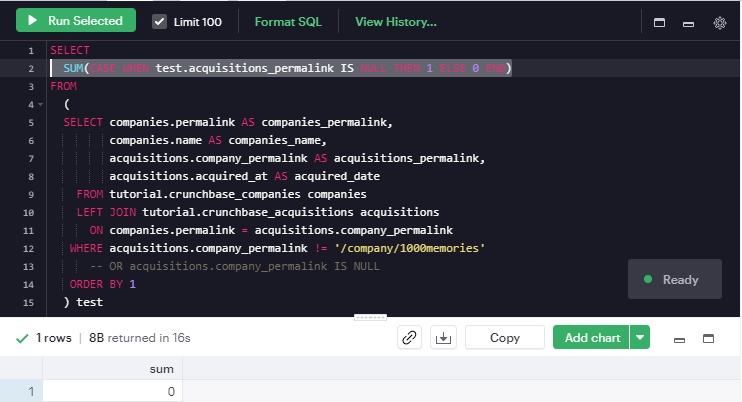
When merging tables with selected rows in SQL, we often think of using the JOIN statement with the WHERE and the ON clause. The resulting table would depend on the inclusion of filters in the WHERE or the ON clause. To illustrate this difference, I employ the SQL examples from a MODE tutorial page.
Filtering in The ON Clause
SELECT companies.permalink            AS companies_permalink,
       companies.name                 AS companies_name,
       acquisitions.company_permalink AS acquisitions_permalink,
       acquisitions.acquired_at       AS acquired_date
  FROM tutorial.crunchbase_companies         companies
  LEFT JOIN tutorial.crunchbase_acquisitions acquisitions
    ON companies.permalink = acquisitions.company_permalink
   AND acquisitions.company_permalink != '/company/1000memories'
 ORDER BY 1
ORDER BY 1is equivalent toORDER BY companies.permalink
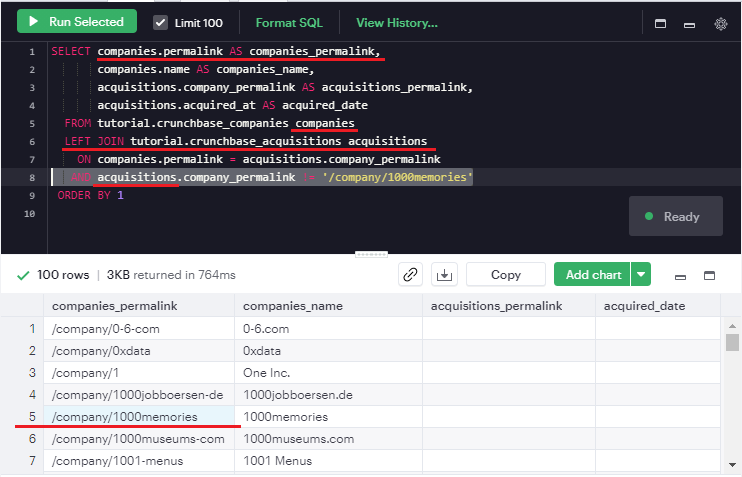
The conditional statement AND... is evaluated before the join occurs. Particularly, the AND statement is evaluated on the joining table (i.e., acquisitions) rather than the target table (i.e., companies). Hence, the 1000memories permalink is still displayed in the column that pulls from the target table (i.e., companies).
Filtering in The WHERE Clause
SELECT companies.permalink            AS companies_permalink,
       companies.name                 AS companies_name,
       acquisitions.company_permalink AS acquisitions_permalink,
       acquisitions.acquired_at       AS acquired_date
  FROM tutorial.crunchbase_companies         companies
  LEFT JOIN tutorial.crunchbase_acquisitions acquisitions
    ON companies.permalink = acquisitions.company_permalink
 WHERE acquisitions.company_permalink != '/company/1000memories'
    OR acquisitions.company_permalink IS NULL
 ORDER BY 1
If you move the same filter to the WHERE clause, you will notice that the filter happens after the tables are joined. The result is that the 1000 memories row is joined onto the original table, but then it is filtered out entirely (in both tables) in the WHERE clause before displaying results (it would have been between the two highlighted lines in the resulting table below).
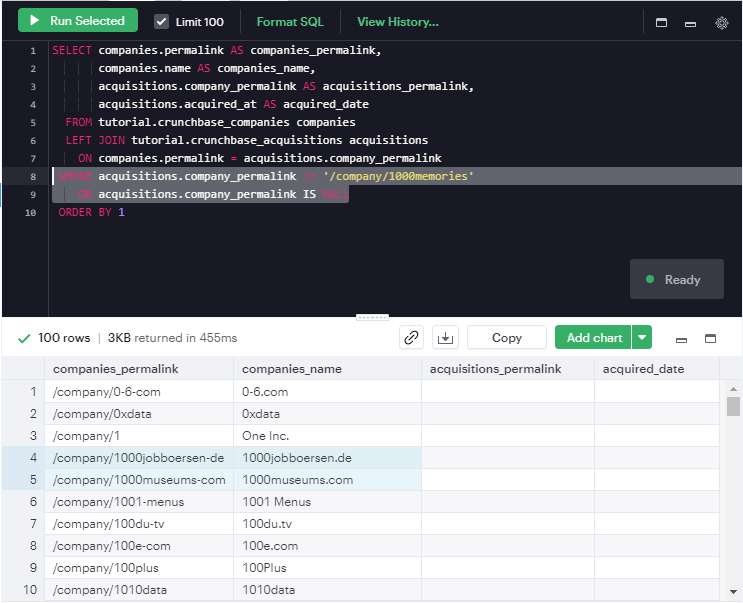
Note that filtering in the WHERE clause can also filter null values, so we added an extra line to make sure to include the nulls.
The null values will not be evaluated using comparison operators.